 Skip-the-line available
 What to See Inside Château de Chambord
The double-helix staircase, the roof terraces, the keep and the park — what to prioritise and in what order.
Chambord is enormous — 440 rooms across a symmetrical keep and surrounding wings — but the visit organises itself around a handful of unmissable spaces, and a clear order of priorities turns a sprawling site into a satisfying half-day. Because the château is largely unfurnished, the experience is about architecture and movement: climbing the famous staircase, emerging onto the roof terraces, reading the building from the gardens, and exploring the park. This guide walks through what to see, in what order, and how to spend your time so you reach the best spaces with energy to spare.
The Double-Helix Staircase
Start at the centre. The open double-helix staircase rises through the heart of the keep and is the single thing most visitors come to see. Two spiral flights wind around a hollow central core lit from above by the lantern tower, arranged so that two people can climb at the same time — one up, one down — and glimpse each other through the openwork without ever sharing the same steps. Walk it slowly, look up through the core toward the light, and climb at least one full flight to feel the geometry; children especially love testing the 'never meet' trick with a companion on the opposite spiral.
The staircase is the connective spine of the visit — it carries you from the ground floor up through the apartments to the roof terraces — so you will use it more than once. It is also the clearest expression of Chambord's Renaissance ambition and the focus of the enduring debate over whether Leonardo da Vinci, who died the year the château was begun, conceived its design. Whatever its authorship, take time here before the building draws you onward; in summer, climbing it early in the day means doing so before the midday crowds fill the core.
The Roof Terraces and Lantern Tower
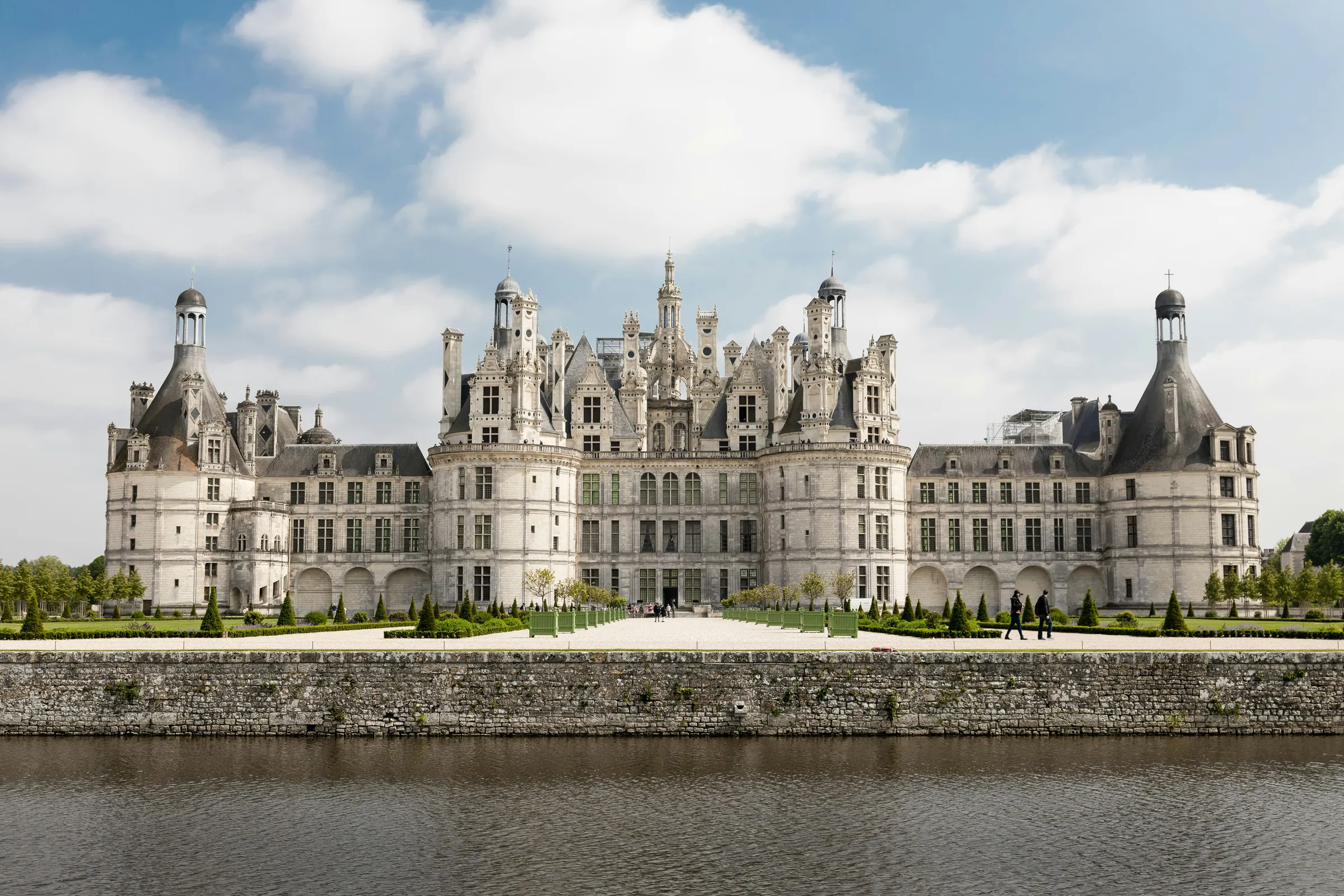
The roof terraces are, for many, the highlight — and the part that surprises visitors who know Chambord only from ground-level photographs. Climbing the staircase to the top brings you out among the forest of chimneys, turrets, dormers and gables that crowd the roofline, with the central lantern tower rising above. The terraces are carved with slate inlay and decorative stonework, and walking among them feels like moving through a sculpted town in the sky. Historically this is where the court gathered to watch the hunt set out and return across the park, and to see and be seen during festivities below.
From the terraces the whole estate reads at once: the formal French gardens directly below to the north and east, and beyond them the walled park stretching to the horizon — 52.5 square kilometres, the largest enclosed park in Europe. Give the terraces real time and walk their full circuit; the views change with every side of the building, and the roofscape itself repays close looking. This is the best spot for photography in low morning or late-afternoon light, and the one space at Chambord that no visitor should rush.
The Keep, Apartments and HistoPad
The keep's floors hold the royal and ceremonial apartments, the vaulted halls and the chapel. Because most original furniture was dispersed during the Revolution and the 19th century, many rooms are shown sparsely or with period pieces brought in for context, so the pleasure here is architectural — the proportions, the great vaulted ceilings carved with the royal salamander and 'F' emblems of François I, and the play of light through the tall windows. A handful of rooms are presented as furnished interiors to give a sense of how the château looked when occupied, including 18th-century apartments from later royal use.
To bring the empty rooms to life, the HistoPad digital tablet — available as an add-on at the entrance — overlays 3D reconstructions of how spaces once looked, room by room, in several languages and with a children's mode. It is the single best way to read the château's history as you move through it and is well worth adding, especially for families or first-time visitors who want more than the bare architecture. Move through the apartments at a steady pace; they are the connective tissue between the staircase and the terraces rather than the climax of the visit.
The Gardens and the Walled Park
Don't leave without stepping outside. The 6.5-hectare formal French gardens on the north and east façades — re-created in 2017 from the 18th-century design — are included with your ticket and give the best ground-level vantage on the château's full symmetry and roofscape; a slow loop here, ideally at the start or end, frames the building far better than any view from up against its walls. The gardens are at their freshest from May to September but the structural geometry reads year-round.
Beyond the gardens, the walled park is half the visit if you have time. You can hire bikes, take an electric cart, row a boat on the canals, or simply walk the avenues; wild boar and red deer roam the reserve and are visible at dawn and dusk from the observation hides, most dramatically during the autumn rut. For families, an hour on bikes or a row on the canal transforms the day. Budget at least an extra hour for the park if the weather is good — Chambord is one of the few châteaux where the grounds rival the building.
Frequently asked
What is the must-see inside Chambord?
The open double-helix staircase and the roof terraces. The staircase is the architectural centrepiece; the terraces, reached by climbing it, are the highlight most visitors remember — a sculpted roofscape with sweeping views over the park.
Is Chambord furnished inside?
Only partly. Most original furniture was lost after the Revolution, so many rooms are sparse or shown with period pieces for context. The visit is mainly architectural; the HistoPad tablet helps reconstruct how rooms once looked.
What is the HistoPad?
A digital tablet, available as an add-on at the entrance, that overlays 3D reconstructions of each room as it once appeared, in several languages and with a children's mode. It's the best way to bring the largely unfurnished rooms to life.
How long do I need inside?
Allow 2.5 to 3 hours for the keep, staircase and roof terraces. Add 1 to 2 hours for the gardens and park. A full day is easy if you cycle or boat in the park.
Can I climb to the roof terraces?
Yes — the double-helix staircase carries you up to the roof terraces, the highlight of the visit. They involve steps and uneven historic surfaces, so they are difficult for wheelchair users; staff can advise on accessible routes.
Are the gardens included in the ticket?
Yes. The 6.5-hectare formal French gardens and access to the walled park are included with your château ticket. The gardens give the best ground-level view of the building's symmetry.
What should I see first?
Climb the staircase to the roof terraces early, especially in summer, before midday crowds. Then work down through the apartments, and finish outside with the gardens and park for the best light and the full view of the building.
Is it interesting for children?
Yes. The double-helix staircase fascinates kids, the roof terraces feel like a storybook castle, the HistoPad has a children's mode, and the park offers bikes and boats. Under-18s enter free at the gate.